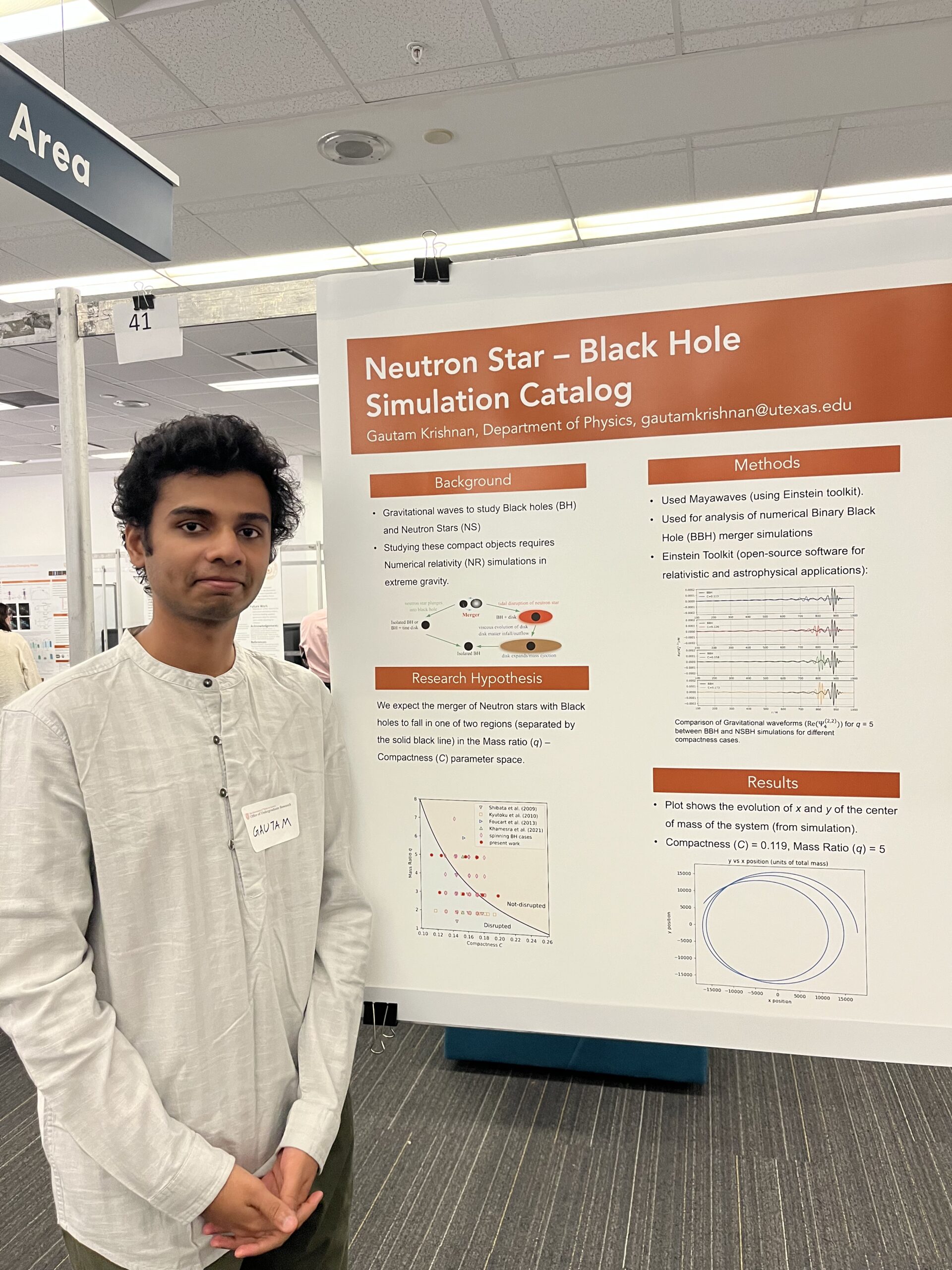
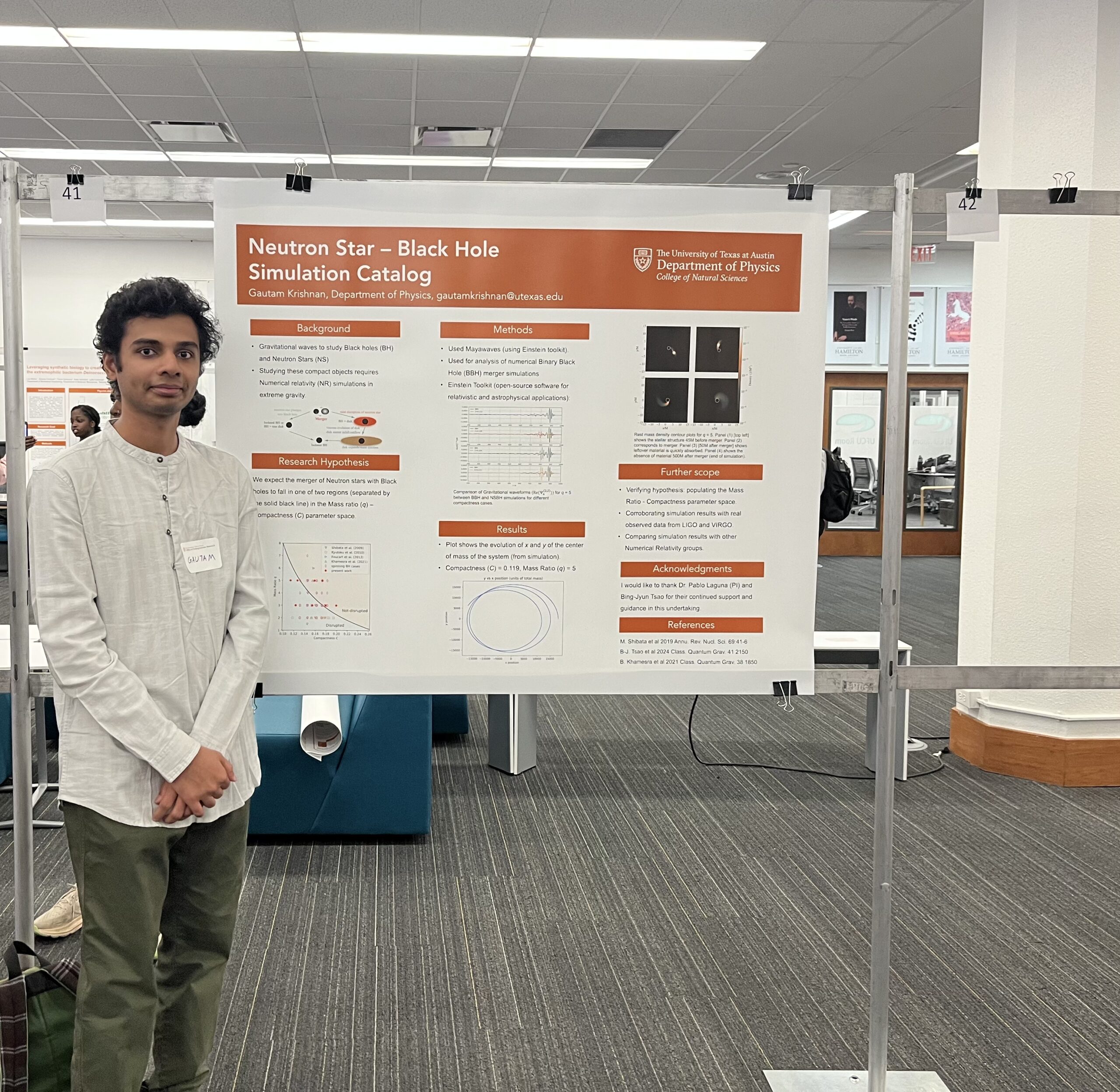
I investigated whether the Neutron Star (NS) would be tidally disrupted based on the compactness (C) and mass ratio (q) of the neutron star. I used Maya to create Gravitational wave data, and analyzed the resulting waveforms. The long-term goal of the project was to populate the Mass Ratio – Compactness parameter space, in essence making an NSBH catalog, to study the event of disruption of the Neutron Star as a function of the two parameters (using the Equation of State of the NS). Regardless of the event of disruption, the remnant left would eventually form an isolated black hole. If not disrupted, the Neutron Star is engulfed whole by the black hole. Otherwise, the Neutron Star disrupts into a disk, which is eventually accreted by the Black Hole.
As the compactness of the Neutron Star increased, the binary system mimicked a Binary Black Hole system. This is evident from the gravitational waveforms obtained leading to, during, and after inspiral. From the simulations run, the data agreed with the disruption curve as outlined in the 2024 B-J Tsao paper published in the Classical & Quantum Gravity Journal.
Presented my findings through a Poster Presentation in April 2025 at the Undergraduate Research Week.
Acknowledgements: I would like to thank Dr. Pablo Laguna (PI) and Bing-Jyun Tsao (Graduate Student) for their continued support and guidance in this undertaking.